 Image: Hannes Grobe (CC BY 4.0)
The thousand-year loop of a drop of deep water
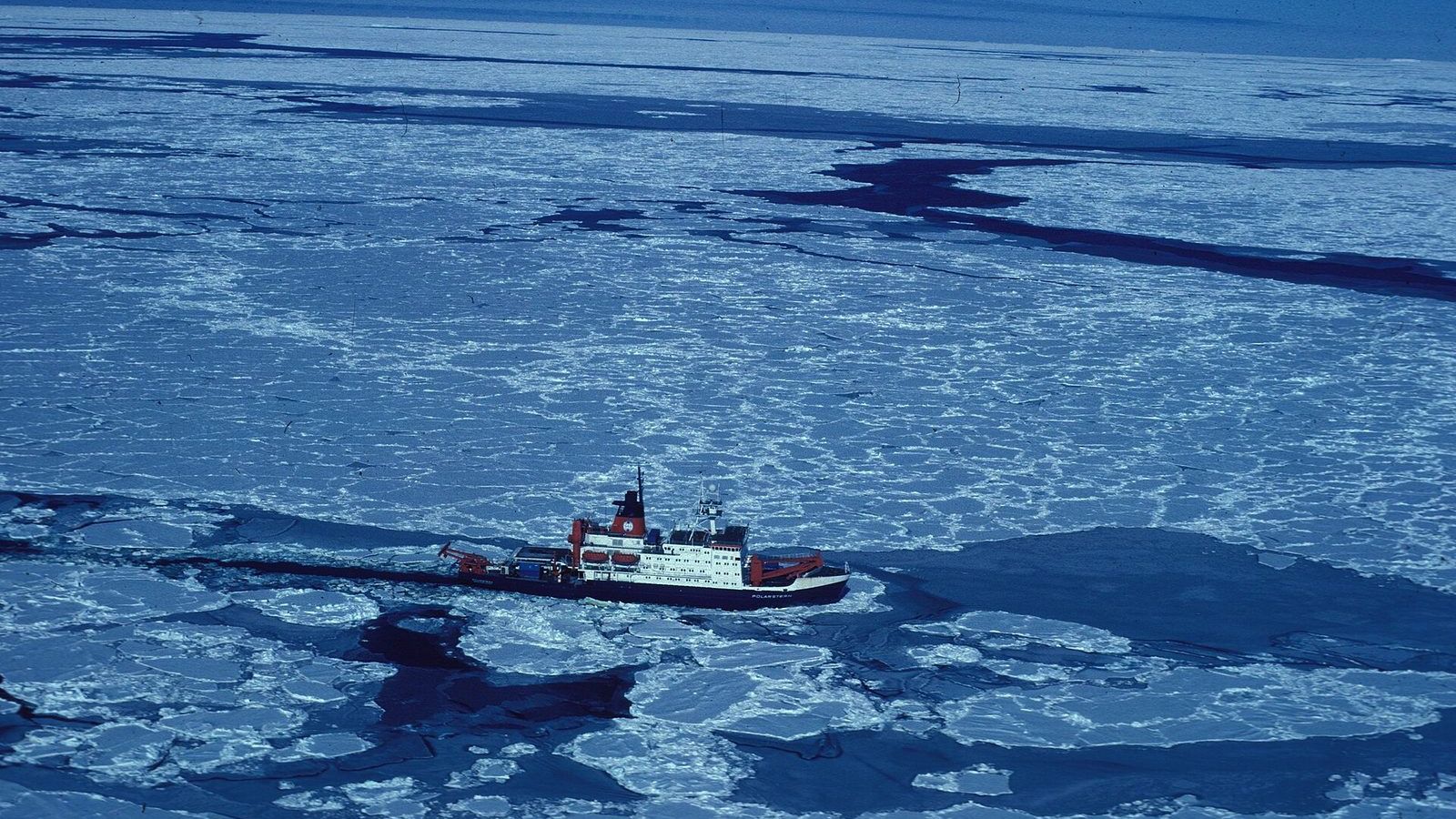
On a February night in the Labrador Sea, with the air at −20 °C and a gale from the north-west, the surface water cools until it is denser than the water beneath it, and it sinks. Not far; a few hundred metres on a quiet night, and 2,000 m in a hard winter, in plumes a kilometre across that the ships can measure. The water that sinks has a temperature of about 3 °C and a salinity of 34.9, and once it has left the surface it will keep both for a very long time, because nothing in the deep ocean warms it or salts it. It will be back at the surface, on average, in about a thousand years, on the other side of the planet. This is the overturning circulation, which Wallace Broecker drew in 1987 as a conveyor belt, and this is the route.
Where the water goes down
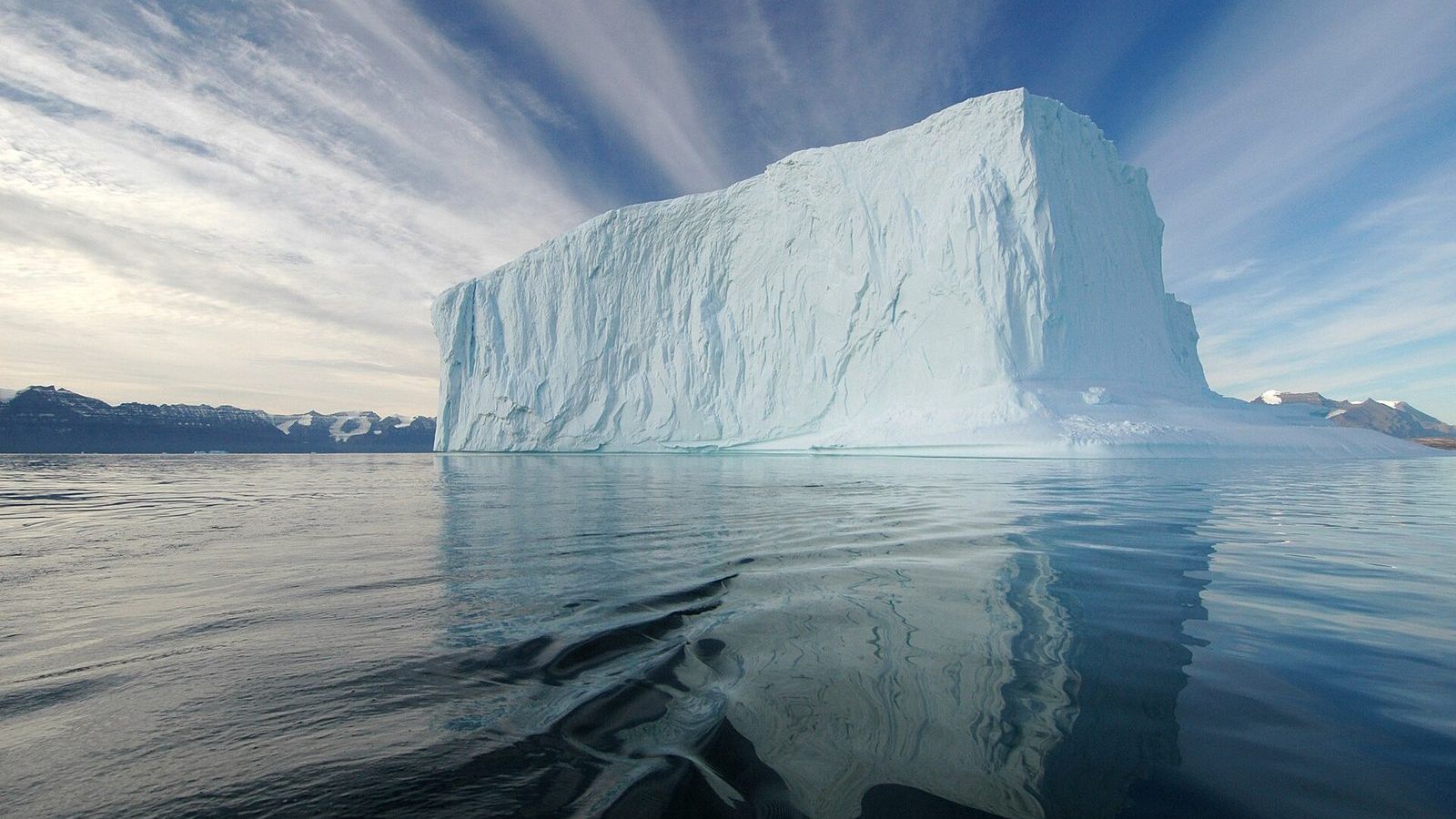
Deep water forms in only a few places, because only a few places make surface water dense enough. The Nordic Seas between Greenland and Norway are one: Atlantic water arrives salty, cools in winter, and sinks, then spills over the ridges between Greenland, Iceland, and Scotland as overflows, each a few sverdrups, that tumble down into the deep Atlantic. The Labrador Sea is another, where the sinking is open-ocean convection rather than an overflow. In the Southern Hemisphere the Weddell and Ross Seas make the densest water of all, by a different route: when sea ice forms on the Antarctic shelves it rejects its salt into the water below, and that cold brine slides down the continental slope to the bottom. The northern product is North Atlantic Deep Water, which fills the Atlantic between about 2,000 and 4,000 m; the southern product is Antarctic Bottom Water, which lies underneath it and covers most of the floor of the world ocean.
South through the Atlantic
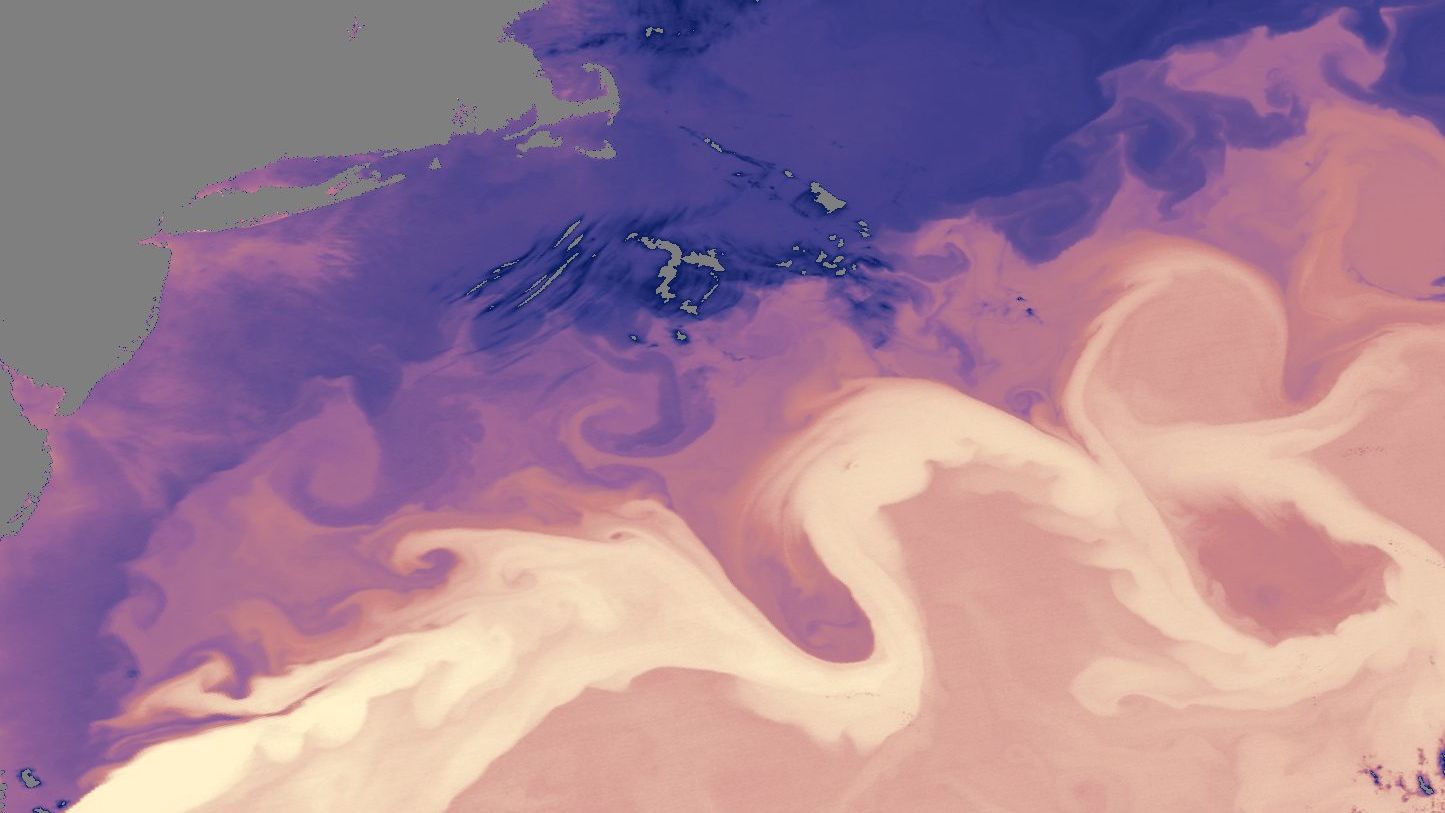
The newly formed deep water does not spread evenly. It gathers against the western side of the Atlantic, for the same reason the Gulf Stream does at the surface, and flows south as the deep western boundary current, which Henry Stommel predicted in 1958 before anyone had measured it. Off the coast of Brazil it moves at 10 to 20 cm/s, which is 10 to 15 km a day; at that rate the 10,000 km from the Labrador Sea to the equator takes two to three years, and floats released into the current have confirmed journeys of that length, though most of them wander off into the interior and take far longer. The Atlantic as a whole carries about 17 Sv of this water southward across 26.5° N, where the RAPID array has measured it since 2004, and about 1.2 petawatts of heat northward in the warm water that replaces it. Most of the deep water reaches the Southern Ocean within a few decades.
Round the Southern Ocean and north again
The Antarctic Circumpolar Current is the only current that circles the globe, and it is the mixing bowl of the deep ocean. North Atlantic Deep Water joins it, is stirred with the water of the Indian and Pacific Oceans into Circumpolar Deep Water, and takes one of two routes out. Some of it is drawn to the surface south of the current by the westerly winds, which push the surface water north and pull deep water up to replace it; this water either freshens and sinks again as intermediate water, or freezes into the bottom water that starts another loop. The rest spreads north at depth into the Indian and Pacific basins, where there is no deep water formation of their own, and fills them from the bottom. The Pacific is so large, and the inflow so slow, that the deep North Pacific is the end of the line. Its water is the oldest in the ocean.
How the age is measured
The clock is radiocarbon. Carbon-14 is made in the atmosphere and taken up by the surface ocean, where seawater is close to equilibrium with the air. Once water leaves the surface it takes in no new carbon-14, and the stock it carries decays with a half-life of 5,730 years. Measure how much is left and you have the time since the water was last at the surface. The conventional radiocarbon age, which uses the older Libby half-life and a mean life of 8,033 years by agreement, is
\[ t = -8{,}033\,\ln\!\left(\frac{A}{A_0}\right), \]where \(A/A_0\) is the activity relative to the surface value. Deep water in the North Atlantic has lost about 8 per cent of its carbon-14, which gives an age of about 700 years, though much of that is a correction for the fact that surface water is itself a few hundred years "old" relative to the air. The deep North Pacific has lost about 24 per cent, an age of about 2,200 years uncorrected and 1,500 to 2,000 years after corrections for mixing and the surface reservoir. The thousand years of the headline is the mean for the whole deep ocean; the Pacific end is older and the Atlantic end younger.
A second clock gives the same answer from the top down. The volume of the ocean below about 1,000 m is roughly \(10^{18}\) m³, and new deep water forms at about 30 Sv, counting both hemispheres. The residence time is the volume divided by the rate, \(10^{18} / (3 \times 10^{7})\) seconds, which is \(3.3 \times 10^{10}\) s, or a little over a thousand years. Two methods, one from radioactive decay and one from plumbing, agree, and that agreement is why the number is trusted.
Why it is not a belt
Broecker's cartoon shows a tidy ribbon. The real circulation is not tidy. Most of the deep water takes the long way, wandering in eddies and recirculations before it finds the exit. Most of the upward return is in the Southern Ocean, not spread over the basins as the older textbooks assumed, and the rest is by mixing across the thermocline, driven by the breaking of internal waves over rough seafloor. Walter Munk pointed out in 1966 that to lift the deep water back up against the stratification takes energy, about two terawatts of it, which has to come from the tides and the wind; the conveyor is powered from outside, not by the sinking at the poles. And the overturning of the subpolar North Atlantic turns out to happen mostly east of Greenland, not in the Labrador Sea where the models expected it, as the OSNAP array has shown since 2014. The drop of water still makes the loop; it just does not follow the arrows.
Unit 8 of the Ocean Masterclass follows the deep water from formation to return with the water mass tracers, the RAPID measurements, Munk's energy argument, and the radiocarbon clock worked with real values from the GLODAP database. The full list of units is in the curriculum.