The bow of a survey ship drives into white spray on a grey sea under a low overcast sky. Sky extended and horizon levelled.

Ocean Masterclass

Ocean Masterclass: 12-Week Program in Oceanography

Study the currents, waves, tides, and deep circulation of the world ocean one unit per week, with the published research of oceanographers working today.

  • Certificate
  • Online
  • Join a community of 2000+
Photo ATSB, photo by James Hancock, CC BY 4.0

Our alumni study at

  • Massachusetts Institute of Technology
  • Harvard University
  • Stanford University
  • California Institute of Technology
  • Princeton University
  • University of Oxford
  • ETH Zurich
  • Imperial College London

About the program

The Ocean Masterclass takes you through the physics, chemistry, and history of the ocean one unit at a time. You enrol, and from then on a new unit reaches you every week. Each unit is a chapter written for this program, with worked examples based on real measurements from ships, floats, and satellites, and the published research of oceanographers who are active today.

A quiz completes every unit and opens the next. At the end you sit a final exam and receive an official certificate with a public verification page.

  • Structured. A fixed curriculum that starts with the shape of the ocean basins and ends with the ocean's part in a changing climate.
  • Demanding and fair. Real physics with real numbers, explained step by step, with school mathematics as the starting point.
  • Recognized. An official certificate and transcript, both with a verification ID that anyone can check on this website.
How the program works
Crew in red helmets at the rail of a research vessel guide a CTD rosette, a frame of grey sampling bottles, over the side above a blue sea. Cropped.
A CTD rosette goes over the side of the French research vessel Pourquoi pas? in 2021. The sensors at its base record conductivity, temperature, and depth on the way down, and the grey bottles close at chosen depths to bring seawater back to the deck. Unit 3 shows how to read the profile it records. Photo Olivier Dugornay, Ifremer, CC BY 4.0

Who is this program for?

For high school students, university students, and lifelong learners. You do not need prior knowledge of oceanography: Unit 1 gives every participant the same toolkit.

Fishing boats afloat at high tide beside a wooden wharf in the harbour at Alma.High tide
The same boats resting on the mud below the wharf at low tide.Low tide
The harbour at Alma, Bay of Fundy, at high and at low tide. In the Bay of Fundy the tide rises and falls by up to about 16 metres, the largest tidal range on Earth (Unit 6). Photos Dylan Kereluk, CC BY 2.0

High School Students

You want to understand how the ocean works and get ahead in the Earth sciences early. The masterclass prepares you for a degree in the field and for the IESO and the Ocean Sciences Bowl.

  • School mathematics is enough
  • Certificate for applications
  • Ideas for a school research project
University Students

A supplement to a degree in physics, geography, Earth sciences, or environmental science. Use it to prepare for a dissertation, a first research cruise, or a first project with ocean data.

  • Worked examples with real data
  • Current research papers
  • Open data sets that researchers use

Lifelong Learners

You sail, surf, or swim in the sea, or you want to know why the tide comes in twice a day. The masterclass takes you through oceanography step by step.

  • No deadlines, pause any time
  • Unit 1 refreshes the mathematics
  • Read on screen or as PDF

Research presented in the program

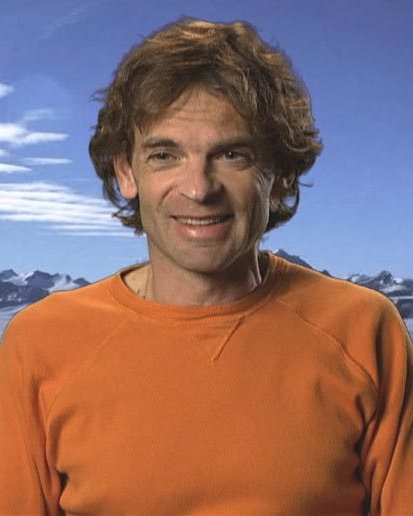
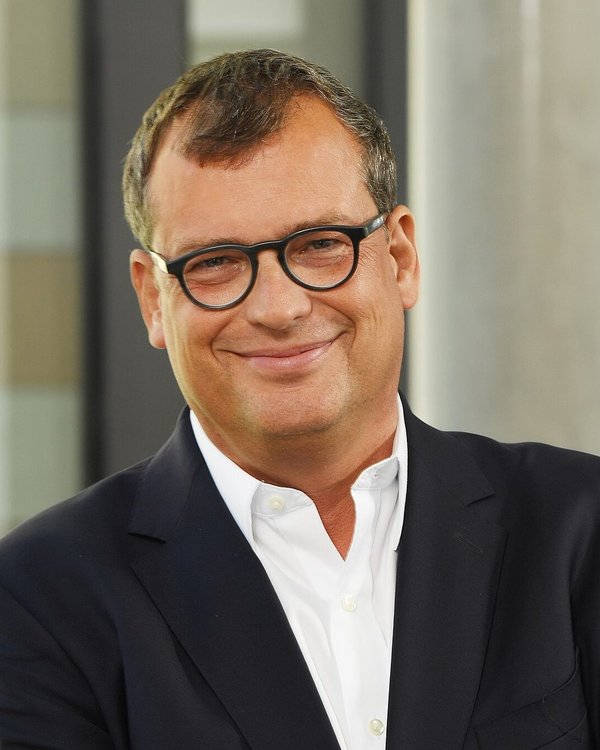
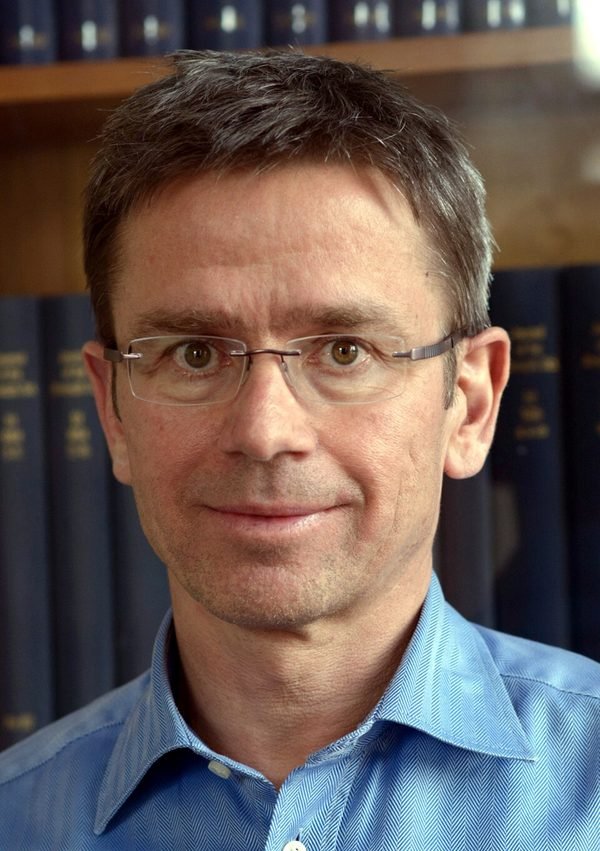
Every unit contains a research spotlight: the published work of an oceanographer active today, explained at your level and linked to the original paper.

The scientists named here are not contributors to the Ocean Masterclass, are not affiliated with it, and have not endorsed it. The program presents and explains their published research, with references to the original papers.

All research spotlights

How does it work?

From enrolment to certificate in six steps.

The research icebreaker Polarstern at night in the Arctic sea ice, its searchlights cutting through blowing snow. Cropped.
The research icebreaker Polarstern in the polar night during the MOSAiC expedition, 2019 to 2020. Photo Alfred Wegener Institute, S. Hendricks, CC BY-SA 3.0 IGO
  1. Enrol

    Create your account with your email address, choose your masterclass, and pay the Tuition Fee. Your program starts at once.

  2. Receive your unit

    Unit 1 arrives immediately and every further unit on a Monday, as a web page and as a PDF to keep.

  3. Study

    Work through the text, the worked examples, and the research spotlight, and answer the questions in the text as you go. A day later we send further reading, including research papers that are free to read.

  4. Take a quiz for every unit

    Each unit has its own quiz: ten questions, open book, no time limit. You submit it before the next unit is sent to you.

  5. Sit the final exam

    50 questions across all units of your masterclass in 60 minutes, open book. Pass with 70%, with up to 3 attempts.

  6. Earn your certificate

    Certificate and transcript as PDF, each with a verification ID and a personal link you can share.

What you will study

16 units in three groups, from the shape of the ocean basins to the ocean's past. Foundation covers Units 1 to 8, the 12-week Advanced masterclass continues to Unit 12, and Advanced + Paleoceanography adds Units 13 to 16.

Hurricane Isabel seen from the International Space Station: a white spiral of cloud with a clear eye, the curve of the Earth and black space above. Space extended.
Units 1 to 8, in every masterclass

How the Ocean Works

Hurricane Isabel from the ISS, September 2003. Photo Ed Lu, NASA, public domain

The shape of the ocean basins, the salt and heat in seawater, the winds and currents, the waves and tides, the chemistry of the sea, and the slow overturning that links every ocean.

  1. 1The Oceanographer's Toolkit
  2. 2Ocean Basins and the Seafloor
  3. 3Salt, Heat, and the Density of Seawater
  4. 4The Ocean and the Atmosphere
  5. 5Wind-Driven Currents and the Great Gyres
  6. 6Waves and Tides
  7. 7Seawater Chemistry and the Ocean Carbon Cycle
  8. 8The Global Overturning Circulation

Every unit comes with worked examples from real measurements, a research spotlight, a tool of the field, and a quiz.

Full curriculum

Tuition Fee and what you receive

Choose the masterclass that fits you. One Tuition Fee, paid once, covers all units, quizzes, the final exam, and your certificate.

8 weeks

Foundation

The fundamentals of oceanography: the basins, seawater, currents, waves and tides, and the overturning.

Tuition Fee$35$39
Enrol in Foundation
  • 8 weekly units as web page and PDF
  • Quiz and further reading for every unit
  • Final exam, certificate, and transcript
Topics in this program
  1. 01
    The Oceanographer's Toolkit
  2. 02
    Ocean Basins and the Seafloor
  3. 03
    Salt, Heat, and the Density of Seawater
  4. 04
    The Ocean and the Atmosphere
  5. 05
    Wind-Driven Currents and the Great Gyres
  6. 06
    Waves and Tides
  7. 07
    Seawater Chemistry and the Ocean Carbon Cycle
  8. 08
    The Global Overturning Circulation
  9. 09
    Rotation, Geostrophy, and Ocean Eddies
  10. 10
    Coasts, Estuaries, and Upwelling
  11. 11
    El Niño and Ocean Climate Variability
  12. 12
    Polar Oceans, Sea Ice, and Ice Shelves
  13. 13
    Past OceansReading the Seafloor Archive
  14. 14
    Past OceansThe Ocean in the Ice Ages
  15. 15
    Past OceansAbrupt Climate Changes and the Ocean
  16. 16
    Past OceansWarm Worlds of the Past
16 weeks

Advanced + Paleoceanography

The full program plus four units on the ocean's climate archive, from the ice ages to the warm worlds of the past.

Tuition Fee$85$119
Enrol in Advanced + Paleoceanography
  • 16 weekly units as web page and PDF
  • Quiz and further reading for every unit
  • Final exam, certificate, and transcript
Topics in this program
  1. 01
    The Oceanographer's Toolkit
  2. 02
    Ocean Basins and the Seafloor
  3. 03
    Salt, Heat, and the Density of Seawater
  4. 04
    The Ocean and the Atmosphere
  5. 05
    Wind-Driven Currents and the Great Gyres
  6. 06
    Waves and Tides
  7. 07
    Seawater Chemistry and the Ocean Carbon Cycle
  8. 08
    The Global Overturning Circulation
  9. 09
    Rotation, Geostrophy, and Ocean Eddies
  10. 10
    Coasts, Estuaries, and Upwelling
  11. 11
    El Niño and Ocean Climate Variability
  12. 12
    Polar Oceans, Sea Ice, and Ice Shelves
  13. 13
    Past OceansReading the Seafloor Archive
  14. 14
    Past OceansThe Ocean in the Ice Ages
  15. 15
    Past OceansAbrupt Climate Changes and the Ocean
  16. 16
    Past OceansWarm Worlds of the Past

Tuition fees are one-time payments and include applicable taxes. Secure payment by card through Stripe.

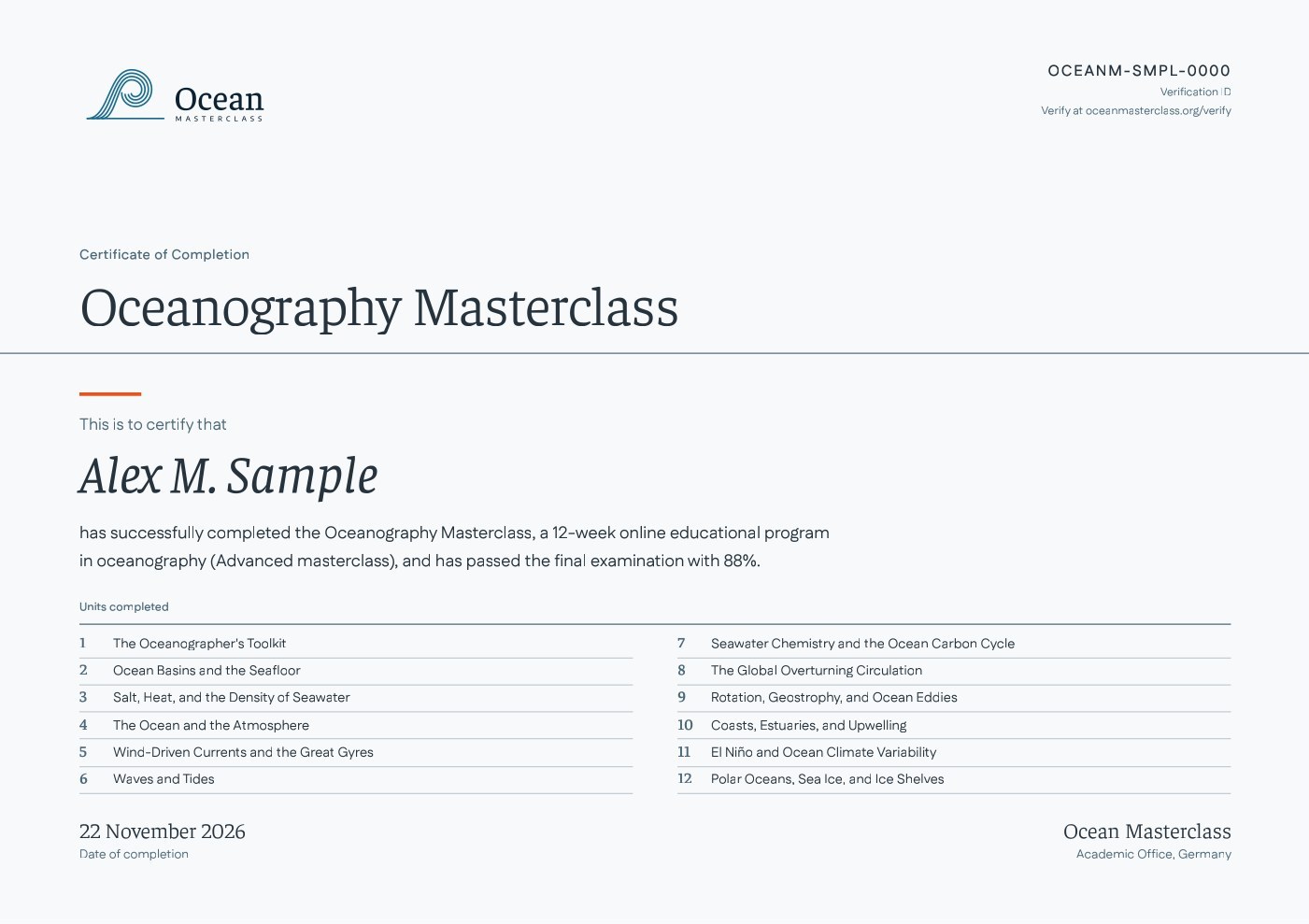
Sample certificate of completion of the Oceanography Masterclass

Your certificate

Participants who pass the final exam receive an official certificate of completion. It states your name, the masterclass, its duration, and the units you completed.

  • Certificate and transcript. The transcript lists your score in every unit quiz and in the final exam.
  • Verifiable. Both documents carry a verification ID that can be checked on this website.
  • Shareable. Your personal verification link shows your result to universities, scholarship committees, and employers.
NASA visualization of the Gulf Stream as a band of warm orange and red water flowing from the Gulf of Mexico towards Europe, with cooler green and blue water to the north. Space extended.
Sample unit, Unit 5

Wind-Driven Currents and the Great Gyres

Gulf Stream, NASA Scientific Visualization Studio, Greg Shirah, public domain

How the wind and the rotation of the Earth drive the great current loops of every ocean

A steady wind does not push the surface water straight ahead. The rotation of the Earth turns it, and the result is the Ekman transport and the gyres that fill every ocean basin. This unit explains the Coriolis effect, the Ekman spiral, the hill of water in the middle of a gyre that satellites measure to the centimetre, and why the Gulf Stream is narrow and fast while the Canary Current is broad and slow.

Read one complete unit before you enrol, exactly as participants receive it: 15 pages with worked examples, figures, and a research spotlight.

Academic community

Masterclass participants come from all over the world, and when you complete the program you stay part of a network that keeps you close to the ocean and to the people who study it.

A wave of white water and turquoise sea breaks over the pipework on the deck of a tanker in the Gulf of Alaska.
  • 2000+Ocean academics in our community
  • 90+Countries represented
  • 750+Schools and universities represented
Rogue wave on the tanker Overseas Chicago. Photo Captain Roger Wilson, NOAA Photo Library, public domain

Ocean-Connect

Our alumni program introduces former participants to one another across countries: for study advice, exchange about university applications, and shared projects.

Opportunities

Past participants hear from us about scholarships, competitions, summer schools, and other academic opportunities in oceanography and climate science.

A place in science

The program shows you how ocean research is done and where it happens, at sea, in the laboratory, and in the data, so that your next step at school, at university, or beyond is an informed one.

The academic community

Frequently asked questions

Who is this program for?

For high school students, university students, and lifelong learners. High school students use it to get ahead in the Earth sciences and to prepare for university or for competitions such as the International Earth Science Olympiad. University students in physics, geography, Earth sciences, or environmental science take it next to their degree, often before a first research cruise or a first project with ocean data. Lifelong learners, among them many sailors, surfers, and divers, use it to understand the sea they already know. The Foundation masterclass suits a first contact with the subject; the Advanced masterclass goes on to the rotating ocean and its eddies, coasts and upwelling, El Niño, and the polar oceans.

What do I need to know before I start?

School mathematics is enough: percentages, powers of ten, simple equations, the trigonometry of a right triangle, and reading a graph. You need no prior knowledge of oceanography, geology, or chemistry beyond school level. Unit 1 builds every tool the later units use, including scientific notation, rates, latitude and longitude, density, hydrostatic pressure, and heat capacity, and each calculation is shown step by step. From Unit 9 on, a derivative or an integral may appear inside a derivation box, with every step explained in words; the main text never depends on calculus.

How much time do I need each week?

Most participants spend three to five hours a week: two or three hours on the unit, under an hour on the open-book quiz, and the rest on the further reading and the tool of the week if they want them. The program has no live sessions, so it fits around school, university, or work in any time zone.

Can I finish the program in less than 12 weeks?

Yes. A new unit is scheduled for every Monday, but once you have submitted the quiz of a unit you can ask for the next one ahead of schedule, from your dashboard or from the email we send you. The earliest moment is 24 hours after the previous unit was sent. We recommend the weekly rhythm, because the material needs time to settle, but the pace is your decision.

What happens if I fall behind or have to pause?

Nothing is lost. The next unit is only sent once you have submitted the quiz of the current one, so the program waits for you. You can pause for a week or for a term and continue at any time. There is no penalty and no deadline.

How does a week in the program look?

On Monday you receive the unit by email, as a web page and as a PDF. A day later we send further reading, including current research papers that are free to read, and one free tool of the field, such as the live map of the Argo floats or the tide predictions of NOAA, with two or three things to try in it. During the week you study the unit and take the open-book quiz of ten questions. After you submit it, you see your result with explanations, and the next unit follows on the next Monday.

All questions   More questions? Contact us.

Black and white photograph of a giant wave breaking off the Portuguese coast, a spectator standing on the cliff edge in the foreground. Sky extended, shown in black and white.

Begin your 12 weeks with the ocean

Big waves, Portugal. Photo Luis Ascenso, CC BY 2.0, sky extended