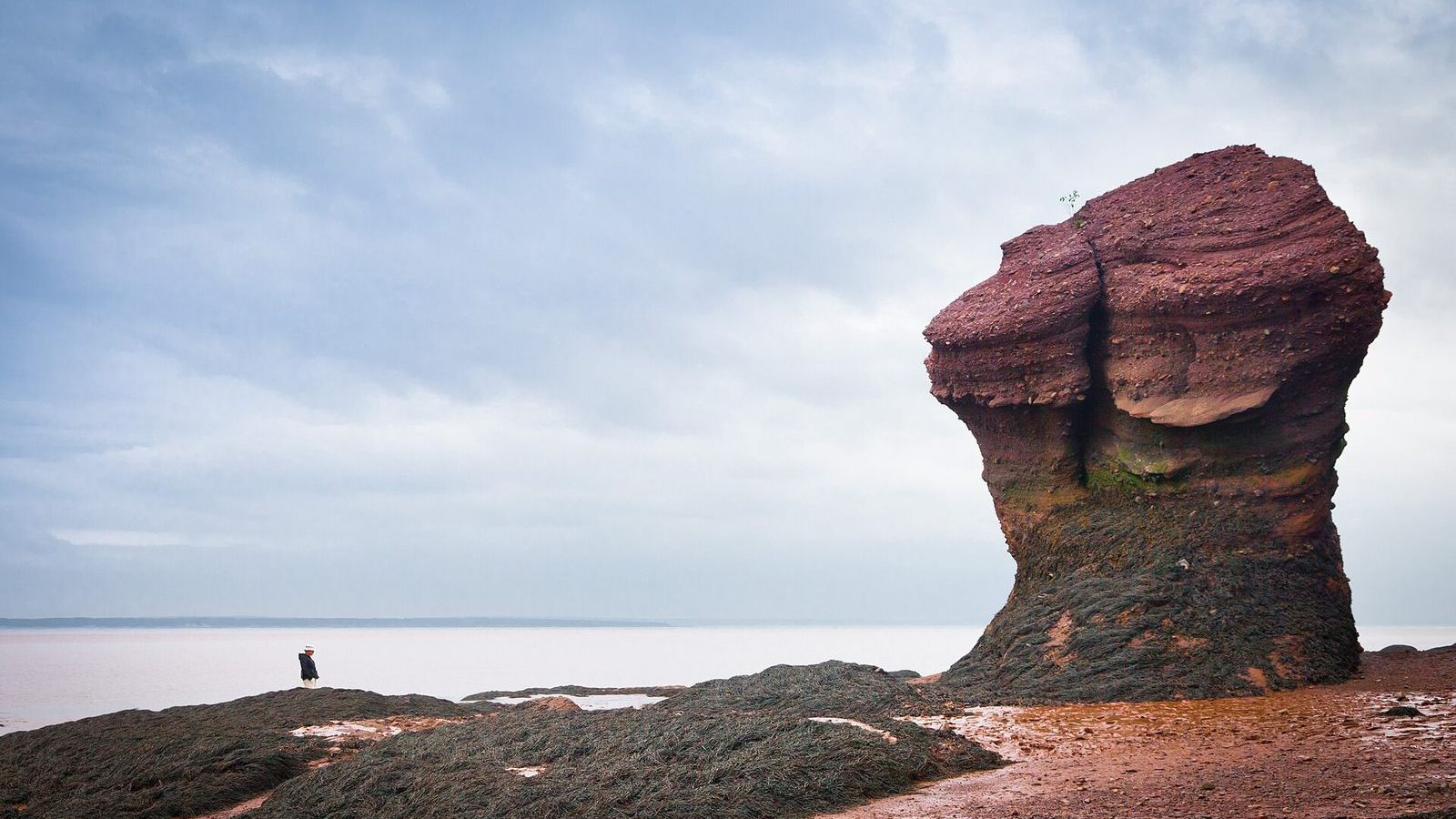
 Image: Benson Kua from Toronto, Canada (CC BY-SA 2.0)
Why the tide comes in twice a day
Most coasts of the world see two high waters and two low waters a day, and the high water arrives about 50 minutes later each day. Both facts are explained by the Moon, and both have been known for a long time; the Babylonians recorded the lag, and Pliny the Elder wrote that the tide follows the Moon. What took until Newton was the reason there are two bulges rather than one, and the reason is not that the Moon pulls the water towards it. The Moon pulls the whole Earth towards it, water and rock alike. The tide comes from the difference.
A difference of two pulls
The gravitational attraction of the Moon falls off as the square of the distance. The side of the Earth facing the Moon is about 6,400 km closer to it than the Earth's centre, and the far side 6,400 km further away. The near side is therefore pulled slightly harder than the centre, and the far side slightly less hard. Seen from the Earth's centre, which is itself falling freely towards the Moon, the near-side water is pulled away from the centre towards the Moon, and the far-side water is left behind, which amounts to a pull away from the Moon. The result is two bulges, one on each side, and two troughs at right angles to them. A point on the rotating Earth passes through both bulges in a day, which is the two high tides.
Because the tide depends on the difference of two inverse-square forces across the Earth's diameter, it falls off not as the square but as the cube of the distance. For a body of mass \(M\) at distance \(d\), the tide-generating force per unit mass at the Earth's surface, radius \(r\), is proportional to
\[ F_{\mathrm{tide}} \propto \frac{M\,r}{d^3}. \]This is the formula that decides the contest between the Moon and the Sun. The Sun is 27 million times more massive than the Moon, but it is 389 times further away, and \(389^3\) is about 59 million. The Sun's tidal force is therefore \(27/59\), or about 0.46, of the Moon's. The Moon's tide is about 2.2 times the Sun's, and the Moon wins although the Sun's direct pull on the Earth is 180 times stronger. The tide is not about how hard you are pulled; it is about how differently your two sides are pulled.
Why 50 minutes later each day
The Earth turns once in 24 hours, but the Moon moves along its orbit in the same direction, about 13° a day, so a point on the Earth needs an extra 50 minutes to catch up with it. The lunar day is 24 hours 50 minutes, and half of it, 12 hours 25 minutes, is the interval between successive high waters of the lunar tide. Tide tables call this constituent M2, and it is the largest almost everywhere. The Sun's semi-diurnal constituent, S2, has a period of exactly 12 hours. The two drift in and out of step over a fortnight: when the Sun and Moon line up, at new and full Moon, their bulges add and the tides are large, the spring tides; when they are at right angles, at the quarter Moons, they partly cancel, the neap tides. Spring tides have nothing to do with the season; the word means "rising", as in a spring of water.
Why the real tide is not two neat bulges
Newton's picture, called the equilibrium theory, gets the periods and the Moon-Sun ratio right and almost everything else wrong. It predicts a tidal range in the open ocean of about half a metre, and a high water at the moment the Moon is overhead. Real coasts see ranges from almost nothing in the Mediterranean to 16 m in the Bay of Fundy, and high water can come hours after the Moon's transit. The reason is that the bulge cannot keep up. For the bulge to follow the Moon around the Earth it would have to travel at about 1,600 km/h at the equator, and a long wave in water 4,000 m deep travels at about 700 km/h. The ocean cannot respond as a static bulge; it responds as a set of waves sloshing in basins bounded by continents, turned by the Earth's rotation. Pierre-Simon Laplace wrote down the equations of that response in 1775, and they are still the equations the tide models solve.
The solution in each basin is a wave that circles a point of no tide, called an amphidromic point, once per tidal period, with the range growing outward from the point towards the coasts. The North Sea has three. William Whewell drew the first charts of these rotating tides in the 1830s from the times of high water reported by harbour masters around the British coast, and found the pattern that nobody had expected. Where a bay is the right length, the tide also resonates. A bay open at one end has a natural period of \(4L/\sqrt{gH}\) for length \(L\) and depth \(H\); the Bay of Fundy, about 270 km long and 70 m deep on average, has a natural period of about 11 to 13 hours, close enough to 12 hours 25 minutes that the Moon pushes it like a child on a swing, and the water at the head of the bay rises and falls by up to 16 m.
Predicting it anyway
Because the tide is the sum of waves with known periods, it can be predicted at any port where it has been measured for long enough, by fitting the amplitude and phase of each constituent and adding them up. Lord Kelvin built the first machine to do the sum in 1872, with pulleys and wires, and tide tables were computed on such machines until the 1960s. Today the sum is done in software with sixty or more constituents, and the result is one of the few forecasts in Earth science that is good years ahead. The NOAA tide service publishes the constituents of thousands of stations; open one and you will find M2 at the top of the list, with S2 below it at a little under half the amplitude, exactly as the inverse-cube law says.
Unit 6 of the Ocean Masterclass derives the tidal force, works out the Moon-to-Sun ratio from the masses and distances, explains the amphidromic systems and the resonance of the Bay of Fundy, and lets you build a month of tides from four constituents in an interactive. The full list of units is in the curriculum.