

Waves and Tides
Waves move energy across the ocean while the water itself barely travels. This unit derives how the speed of a water wave depends on its wavelength and the depth, explains why a tsunami crosses the deep ocean at the speed of an airliner, works out how rare a rogue wave should be, and shows why the tide comes in twice a day and rises a metre at Bergen but sixteen in the Bay of Fundy.
Most of what moves on the sea is a wave of one kind or another. Swell crosses an ocean in a week while the water itself stays almost where it was; a tsunami runs across the Pacific at the speed of an airliner and nobody on a ship notices it pass; and the tide lifts the whole ocean twice a day, in step with a Moon that pulls far more weakly than the Sun. This unit works out the physics of all three with a handful of relations between wavelength, depth, and speed, and ends in the Bay of Fundy with a tide of 16 metres.
1 The anatomy of a wave
A wave on the sea surface is described by four numbers. The wavelength \(L\) is the horizontal distance from one crest to the next, the wave period \(T_{\mathrm{w}}\) is the time between two crests passing a fixed point, the wave height \(H\) is the vertical distance from trough to crest, and the phase speed \(c = L/T_{\mathrm{w}}\) is the speed at which a crest travels. The period carries the subscript w so that the plain letter \(T\) can keep the meaning it had in Unit 3, the temperature. The ratio \(H/L\) is the steepness; no wave can be steeper than about \(1/7\), because its crest then becomes sharper than the water can hold together and it breaks.
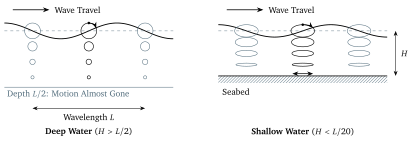
The water under a wave does not travel with it. In deep water each parcel of water moves in a circle whose diameter at the surface equals the wave height and which shrinks quickly with depth, as Figure 1 shows; at a depth of half a wavelength the circles are only about 4 per cent of their surface size, which is why a submarine at \(100\unit{m}\) rides out a storm whose waves, \(10\unit{m}\) high and some \(200\unit{m}\) long, pass above it. In water shallower than half a wavelength the circles flatten into ellipses, and at the seabed the motion is a back-and-forth sloshing, which is what stirs the sand on a beach.
1.1 The dispersion relation
How fast a wave travels depends on its wavelength and on the depth of the water. Gravity is the force that pulls a raised crest back down, so these waves are called surface gravity waves.
The word dispersion means that waves of different wavelengths travel at different speeds. In deep water the long waves are the fast ones, so a mixture of waves sorts itself out as it travels, with the longest in front; in shallow water the wavelength no longer appears in the speed at all, and every long wave, from a tsunami to the tide, travels at \(\sqrt{gH}\) (Figure 2). In deep water the wavelength can be eliminated, because \(L = c\,T_{\mathrm{w}}\) turns \(c^2 = gL/2\pi\) into \(c^2 = g\,c\,T_{\mathrm{w}}/2\pi\), and dividing by \(c\) gives \[ c = \frac{g\,T_{\mathrm{w}}}{2\pi} \approx 1.56\,T_{\mathrm{w}}, \qquad L = \frac{g\,T_{\mathrm{w}}^2}{2\pi} \approx 1.56\,T_{\mathrm{w}}^2 , \] with \(c\) in metres per second, \(L\) in metres, and the period in seconds. The period is the quantity worth measuring, because it is the one thing a wave keeps when it runs into shallower water; the wavelength and the speed shrink there, but the number of crests arriving per minute cannot change, otherwise crests would pile up somewhere.