 Image: Dey.sandip (CC BY 3.0)
Why the sea is salty and not getting saltier
A kilogram of seawater from anywhere in the open ocean holds about 35 g of dissolved salt, and the salt is almost entirely six ions: chloride at 19.4 g, sodium at 10.8 g, sulfate at 2.7 g, magnesium at 1.3 g, calcium at 0.4 g, and potassium at 0.4 g. Everything else dissolved in the sea, from bromide to gold, adds up to less than a gram. Boil the sea dry and the salt would cover the continents to a depth of about 150 m. Where it came from is one question; why there is not more of it is a better one.
Where the salt came from
Rain is slightly acidic, because it dissolves carbon dioxide from the air, and it slowly dissolves the rocks it falls on. Rivers carry the products to the sea: sodium, calcium, magnesium, potassium, bicarbonate, silica. World river water has a total dissolved content of about 0.1 g/kg, a three-hundredth of seawater, and the rivers together deliver about four billion tonnes of dissolved material a year. Some ions do not come mainly from rivers. Chloride and sulfate come largely from volcanic gases and from the hot springs on the mid-ocean ridges, where seawater circulates through fresh basalt, and the chloride in the sea has been there since the ocean formed; the rivers merely recycle it from salt deposits on land. That is why the proportions in seawater are nothing like the proportions in river water. Rivers are rich in calcium and bicarbonate, which the sea removes quickly as shells; the sea is rich in sodium and chloride, which it removes slowly.
Why it is the same everywhere
In 1819 the Geneva chemist Alexander Marcet analysed seawater from the Arctic, the Atlantic, the Mediterranean, and the China Sea and found that although the total salt differed from place to place, the ratios of the ions to one another did not. William Dittmar confirmed it in 1884 on 77 samples that HMS Challenger had brought back from every ocean. The constancy of proportions holds because the ocean mixes in about a thousand years and the major ions stay in it for millions, so they have had time to spread evenly many times over. Only near river mouths, in enclosed seas, and for the few elements that living things use up, such as nitrate and silica, do the proportions change. The practical consequence is that salinity can be measured as a single number: measure one ion, or measure the electrical conductivity, and all the others follow.
How long an ion stays
The useful idea is residence time, the amount of an element in the sea divided by the rate at which it is added, which, in a steady state, is also the rate at which it is removed. The ocean holds about \(1.37 \times 10^{21}\) kg of water, so at 10.8 g/kg it holds \(1.5 \times 10^{19}\) kg of sodium. Rivers deliver about \(2 \times 10^{11}\) kg of sodium a year. The residence time is therefore
\[ t = \frac{1.5 \times 10^{19}\ \mathrm{kg}}{2 \times 10^{11}\ \mathrm{kg/yr}} \approx 7.5 \times 10^{7}\ \mathrm{years}, \]about 75 million years; published estimates range from 50 to 100 million. Chloride stays about 100 million years, magnesium about 13 million, calcium about a million, silica about 15,000, and iron, which is scavenged by particles almost as soon as it arrives, a few hundred. Water itself stays about 3,000 years before it evaporates and falls again as rain. The sea is salty because the salts stay tens of thousands of times longer than the water does.
Joly's mistake
In 1899 the Irish physicist John Joly used the sodium residence time the other way round. If the ocean started fresh and the rivers have been adding sodium ever since, he reasoned, the amount in the sea divided by the yearly input is the age of the ocean, and he got about 90 million years. It was a serious estimate, taken seriously, and it was wrong by a factor of fifty, because the sea is not a bucket that only fills. Sodium leaves. The age Joly computed was the residence time, and the Earth is 4.5 billion years old. The lesson is the one that the whole of ocean chemistry rests on: the sea is a steady state, not an accumulation.
Where the salt goes
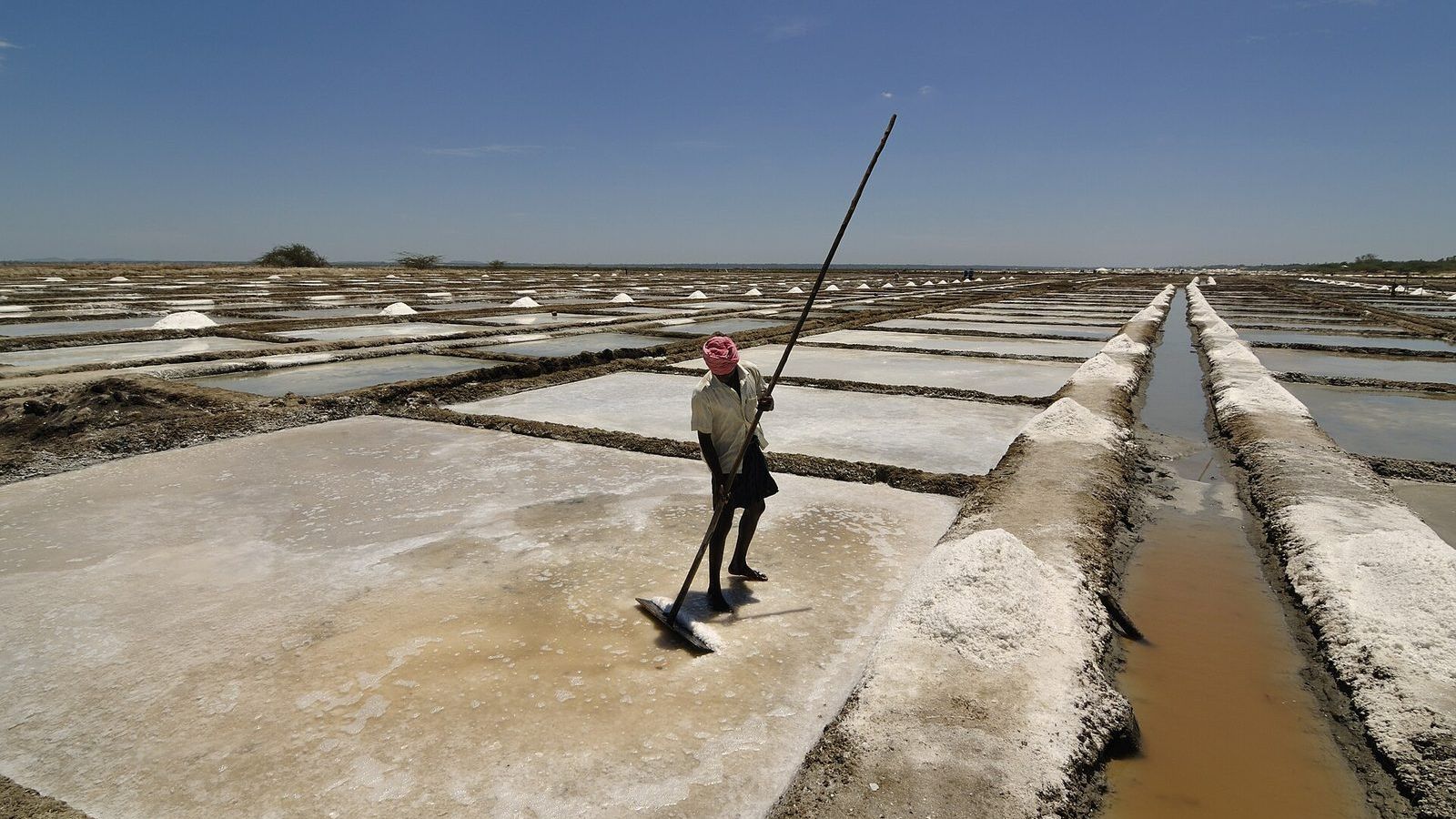
The exits are less obvious than the entrances. Sea spray carries salt onto the land, where the rain washes it back; it is a loop rather than a sink. The real sinks are these. Calcium and bicarbonate leave as the shells of plankton and corals, which become limestone. Silica leaves as the shells of diatoms and radiolarians. Magnesium leaves in the hot springs of the ridges, where it is taken up by the basalt in exchange for calcium, and in the formation of clay minerals. Sodium and chloride leave mostly in two ways: trapped in the pore water of sediments as they are buried, and deposited as salt beds when an arm of the sea is cut off and evaporates. The Mediterranean did this between 5.96 and 5.33 million years ago, when the Strait of Gibraltar closed and the basin dried out, laying down a layer of salt up to 2 km thick that still lies under its floor, about 6 per cent of all the salt in the ocean at the time. Events like that, and the slow burial of pore water, balance the rivers over millions of years. The salinity of the ocean has probably not changed by more than a few grams per kilogram since the Cambrian.
Is it getting saltier now?
Not on average, and not measurably: the inputs and outputs are a few billion tonnes a year against fifty million billion tonnes in the sea, and a change would take millions of years to show. What is changing is the pattern. Argo floats and the older ship data show that since the 1950s the salty subtropical surface waters have become saltier and the fresh waters near the equator and the poles fresher, by a few hundredths of a gram per kilogram per decade. Salt is not being added; water is being moved. More evaporation where it is already dry and more rain where it is already wet is what a warmer atmosphere does, and the ocean's surface salinity is the best record of it that exists, because the ocean is where four fifths of the world's rain falls and nobody keeps a rain gauge there.
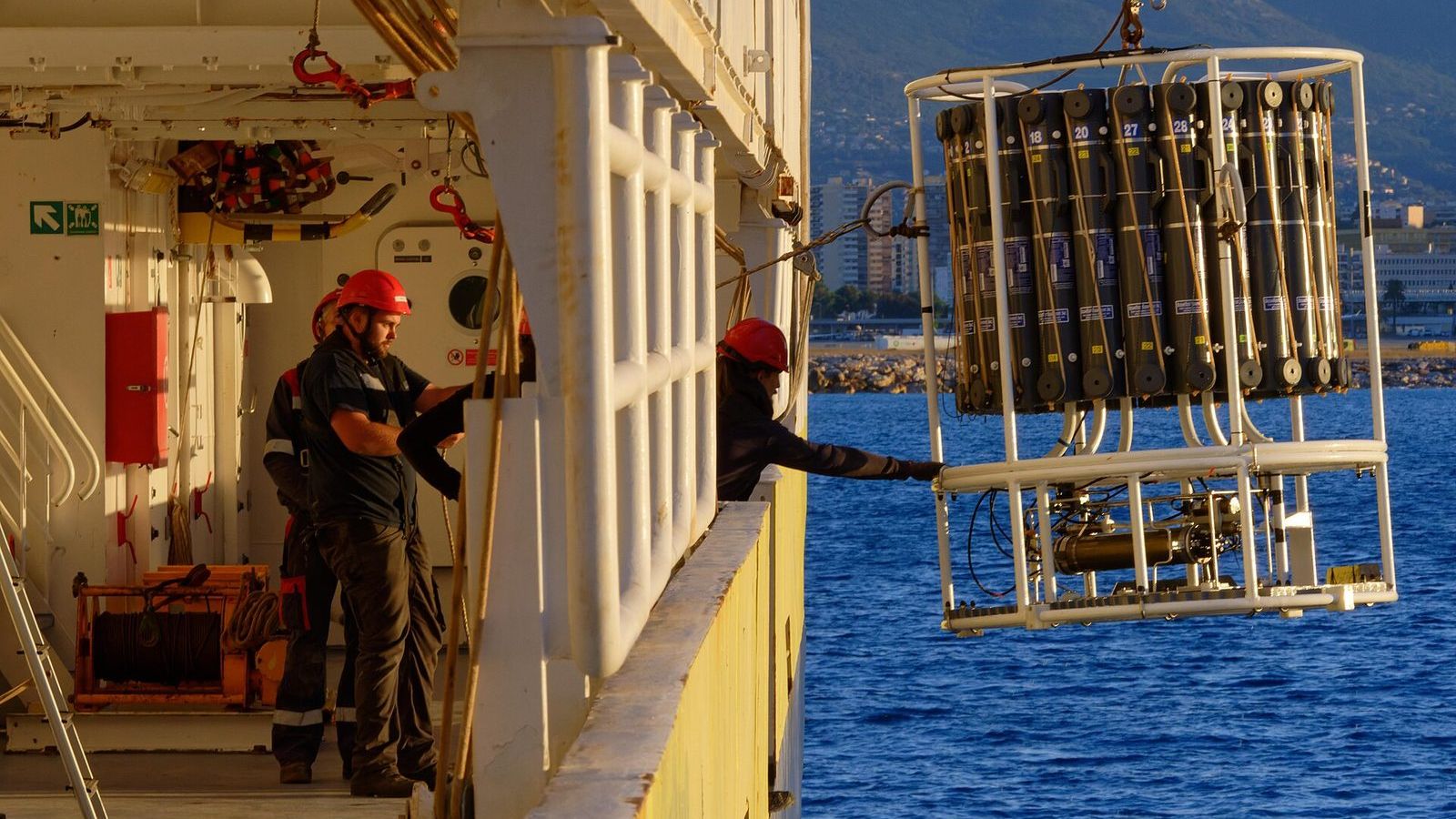
Unit 3 of the Ocean Masterclass gives the major ions in a table, explains the practical salinity scale and how a CTD measures it, works out the mass of salt in the ocean, and presents the salinity fingerprint of the water cycle in a research spotlight. The full list of units is in the curriculum.