 Image: Forrest M. Mims III (Public domain)
How the ocean takes up a quarter of our carbon dioxide
Every year the Global Carbon Project publishes an account of where the carbon dioxide went. The budget for 2024 put the emissions from fossil fuels and cement at about 10.2 billion tonnes of carbon, written 10.2 Pg C, with another 1.1 Pg C from deforestation and land use. Of the total, about 46 per cent stayed in the atmosphere, about 30 per cent was taken up by plants and soils on land, and about 26 per cent, averaged over the last decade, dissolved in the ocean. The ocean sink in 2024 was about 2.9 Pg C, which is 10.6 billion tonnes of carbon dioxide, roughly the weight of all the people, livestock, and wild mammals on Earth, dissolved in the sea in one year, without anyone noticing.
Why the sea can hold so much
Carbon dioxide is only moderately soluble in water; a bottle of soda water holds a few grams per litre under pressure and loses it when opened. If seawater took up carbon dioxide the way fresh water does, the ocean would hold about as much carbon as the atmosphere. It holds about fifty times more, about 38,000 Pg C against about 900 Pg C in the air, because dissolved carbon dioxide in seawater does not stay as carbon dioxide. It reacts with water to form carbonic acid, which gives up a hydrogen ion to become bicarbonate, which can give up another to become carbonate:
\[ \mathrm{CO_2} + \mathrm{H_2O} \rightleftharpoons \mathrm{H_2CO_3} \rightleftharpoons \mathrm{H^+} + \mathrm{HCO_3^-} \rightleftharpoons 2\,\mathrm{H^+} + \mathrm{CO_3^{2-}}. \]At the pH of seawater, about 8.1, the balance sits far to the right of the first step: of the dissolved inorganic carbon in the sea, about 90 per cent is bicarbonate, about 9 per cent carbonate, and less than 1 per cent is carbon dioxide gas in solution. Only that last 1 per cent exchanges with the air. Add carbon dioxide and most of it is converted to bicarbonate, which hides it from the atmosphere, and the sea can take more. The conversion consumes carbonate ions, which is the key to what follows.
Why it cannot hold all of it
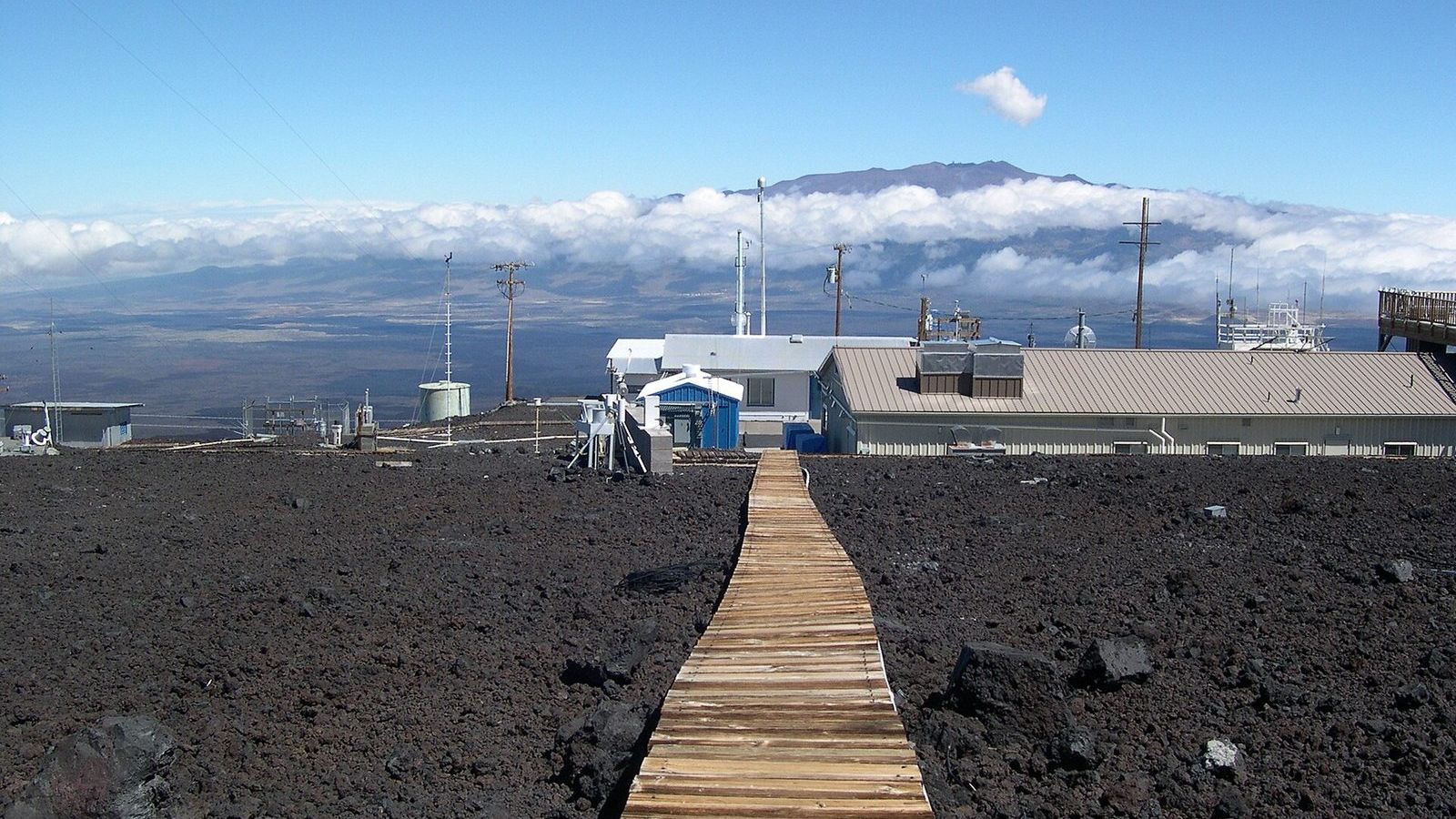
Roger Revelle and Hans Suess worked out in 1957 that this buffering has a limit. Because the added carbon dioxide uses up carbonate ions, each tonne the sea absorbs makes the next tonne harder to absorb. The measure of this is the Revelle factor: a 10 per cent rise in the carbon dioxide in the air raises the total dissolved carbon in equilibrium with it by only about 1 per cent. The sea would, given many centuries, take up about 80 per cent of what we emit, but it takes centuries because only the surface layer, a hundred metres or so, is in contact with the air, and the deep ocean exchanges with it over a thousand years. The quarter that the ocean takes each year is the fraction that the surface layer and the sinking of water at high latitudes can manage in a year. Revelle called the experiment humanity was running on the ocean one that could not have happened in the past and could not be repeated in the future, and he hired a young chemist, Charles David Keeling, to measure the carbon dioxide in the air properly. Keeling's measurements at Mauna Loa began in 1958.
How the sink is measured
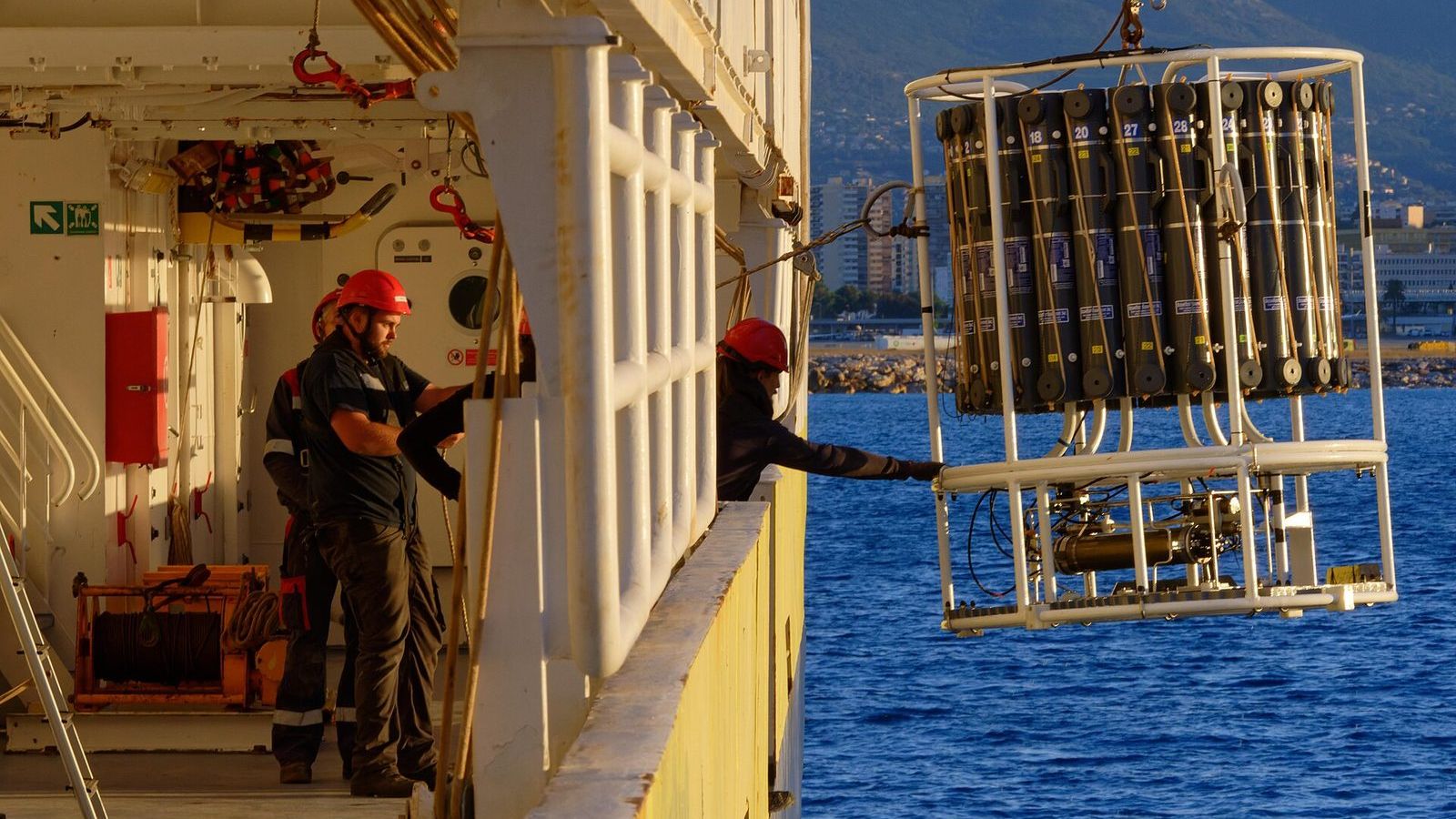
There are two independent ways, and they agree. The first is to measure the partial pressure of carbon dioxide in the surface water and in the air above it from ships and moorings; where the water is below the air, gas goes in, and the rate follows from the difference and the wind speed. The Surface Ocean CO₂ Atlas collects these measurements, tens of millions of them, and the yearly sink in the Global Carbon Budget is built from them and from models constrained by them. The second is to measure the carbon in the water column directly on repeated ship sections across the oceans and watch it grow. Nicolas Gruber of ETH Zurich and his colleagues did this for the whole ocean between 1994 and 2007 and found that the inventory of human-made carbon had grown by 34 Pg C in those thirteen years, which was 31 per cent of the emissions of the period, with the uncertainty allowing anything from 27 to 35 per cent. The two methods, one looking at the surface flux and one at the stored total, bracket the same answer.
The sink is not spread evenly. The Southern Ocean and the North Atlantic take most of it, because that is where cold surface water, which holds more gas, sinks and carries its carbon out of reach of the air. The tropics, where cold deep water comes up and warms, release carbon dioxide back to the air. The map of the sink is the map of where the ocean breathes in and where it breathes out.
The price
The hydrogen ions released in the chemistry above have lowered the pH of the surface ocean from about 8.2 before the industrial era to about 8.1 now. The change looks small because the pH scale is logarithmic. The concentration of hydrogen ions is \(10^{-\mathrm{pH}}\), so a fall of 0.1 is a rise by a factor of \(10^{0.1} = 1.26\), which is 26 per cent more hydrogen ions. The carbonate ion concentration has fallen by a similar fraction, and carbonate is what corals, pteropods, foraminifera, and many molluscs need to build their shells. The depth below which calcium carbonate dissolves has risen by tens to hundreds of metres in the last century, and in parts of the Southern Ocean and the Arctic the surface water is expected to become corrosive to the aragonite form of the mineral within decades. This is ocean acidification, and it is the same reaction as the sink, seen from the other side. The ocean does us a service by taking the carbon, and the service is not free.
You can read the numbers for any year yourself in the Global Carbon Atlas, which is the budget drawn as charts, and compare the ocean sink of 1960, about 1 Pg C, with today's.
Unit 7 of the Ocean Masterclass works through the carbonate system, the Revelle factor, the solubility and biological pumps, the Global Carbon Budget figures, and the 26 per cent rule, with research spotlights on the budget and on the measured inventory. The full list of units is in the curriculum.