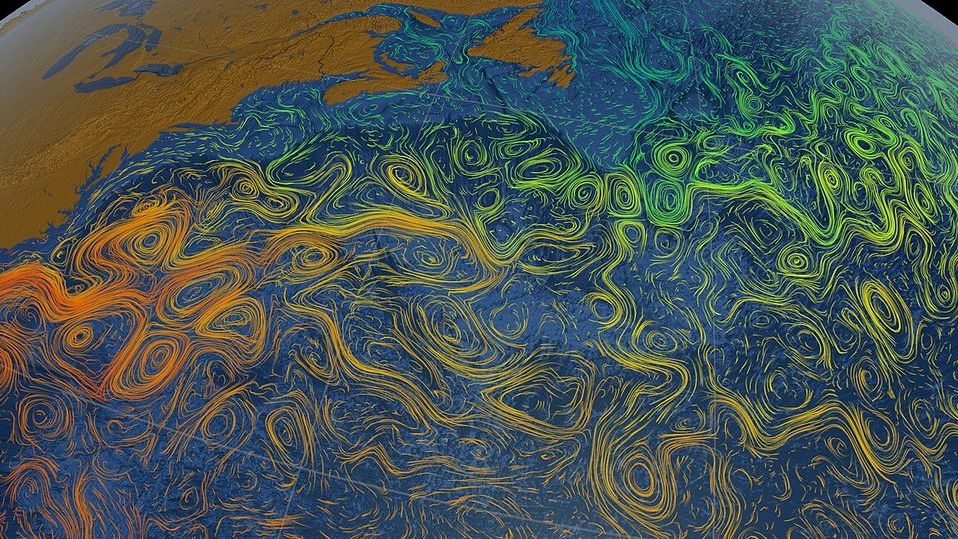
 Image: Greg Shirah (lead animator) (Public domain)
Ten numbers every oceanography student should know
Ask an oceanographer whether a current of 300 Sv is plausible and they will say no before you finish the sentence, because they know that the strongest current on Earth carries about 150. That kind of judgement comes from a small stock of numbers that the field carries around and measures everything else against. These ten are a start. Each comes with the measurement that stands behind it, because a number without its measurement is a rumour.
1. The pressure rises by about 1 atmosphere every 10 m
The hydrostatic equation, \(p = p_{\mathrm{atm}} + \rho g z\), with seawater at 1,025 kg/m³ and \(g\) at 9.81 m/s², gives 1.006 bar per 10 m, and one atmosphere is 1.013 bar, so the rule is good to one per cent. At the wreck of the Titanic, 3,800 m down, the pressure is about 380 atmospheres; in the Challenger Deep it is about 1,100. The decibar, the pressure unit of the field, was chosen because 1 dbar is close to 1 m of depth.
2. The mean depth is about 3,700 m
The ocean covers 361 million km², about 71 per cent of the Earth, and holds 1.33 billion km³ of water, which gives a mean depth of 3,682 m. The figures come from the global bathymetric grids and were tidied up by Charette and Smith in 2010. The deepest point, the Challenger Deep in the Mariana Trench, was fixed at 10,935 m with an uncertainty of 6 m in 2021 by combining multibeam sonar with direct pressure measurements from the bottom. Mount Everest would sit in it with 2 km of water above the summit.
3. One sverdrup is a million cubic metres per second
Named after Harald Sverdrup and written Sv, it is the unit of volume transport, and the reason it exists is that currents are too large for anything smaller. All the rivers of the world together deliver about 1.2 Sv to the sea, and the Amazon alone about 0.2 Sv. Keep 1.2 Sv in mind as the scale of everything that happens on land.
4. The Gulf Stream carries about 90 Sv off Cape Hatteras
Through the Straits of Florida it carries about 32 Sv, measured since 1982 by the voltage induced in a disused telephone cable as the salt water flows across the Earth's magnetic field. By Cape Hatteras, after it has gathered the recirculating water of the gyre, it carries about 90 Sv, roughly 75 times all the rivers on Earth. The Antarctic Circumpolar Current, the largest current of all, carries 130 to 170 Sv through Drake Passage; the best recent measurement, from a mooring array in 2016, gave 173 ± 10 Sv.
5. The Atlantic overturning is about 17 Sv at 26.5° N
The RAPID array of moorings across the Atlantic has measured it continuously since April 2004, and the mean over the record is about 17 Sv, with swings of several sverdrups from year to year and a dip to about 13 Sv in 2009 to 2010. The warm upper branch carries about 1.2 petawatts of heat northward, about 1,200 million million watts, which is roughly seventy times the world's energy use. One loop of this circulation, from sinking in the north to the return of the water to the surface, takes roughly a thousand years.
6. A tsunami crosses the deep ocean at about 700 km/h
A tsunami is a shallow-water wave even in 4,000 m of water, so its speed is \(\sqrt{gH} = \sqrt{9.81 \times 4{,}000} = 198\) m/s, which is 713 km/h. The arrival times of 26 December 2004, two hours to Sri Lanka and seven to East Africa, match it. The same formula gives 80 km/h over a 50 m shelf, which is why the wave slows, shortens, and grows as it comes in.
7. The main lunar tide has a period of 12 hours 25 minutes
The lunar day is 24 hours 50 minutes, because the Moon moves on in its orbit while the Earth turns, and the semi-diurnal tide, M2, has half that period. The solar tide, S2, has exactly 12 hours; the two beat over 14.8 days, which is the spring-neap cycle. The Moon's tidal force is about 2.2 times the Sun's, from the inverse-cube law, and the largest range in the world, up to about 16 m, is in the Bay of Fundy, where the basin resonates close to the M2 period.
8. Sea level is rising about 3.3 mm per year
That is the mean rate since 1993 measured by the altimeter satellites from TOPEX/Poseidon to Sentinel-6; the rate in the most recent decade is over 4 mm per year. From 1901 to 2018 the rise was about 20 cm, from tide gauges. About a third of the recent rise is the expansion of warming water and the rest is ice from glaciers and the two ice sheets. The conversion to remember is that 362 gigatonnes of ice raise the global sea by 1 mm; Greenland holds about 7 m of sea level, West Antarctica 3 to 5 m, and East Antarctica about 50 m.
9. The ocean takes up about a quarter of our carbon dioxide
The Global Carbon Budget puts the ocean sink of the last decade at about 26 per cent of total emissions, about 2.9 Pg C per year, measured from the carbon dioxide in surface water and confirmed by repeated ship surveys of the water column. The ocean has also taken up more than 90 per cent, about 91, of the excess heat accumulated by the climate system since 1971, which is why its heat content is measured in zettajoules: it gained about 10 ZJ per year during the 2010s. The pH of the surface ocean has fallen by about 0.1 since pre-industrial times, which is 26 per cent more hydrogen ions.
10. The glacial atmosphere held about 180 ppm of carbon dioxide
The air trapped in Antarctic ice cores shows that carbon dioxide was 180 to 190 parts per million at the peak of the last ice age, 280 ppm in the warm periods before industry, and about 425 ppm today. At the same time sea level stood 120 to 130 m below today's, the global temperature was about 6 °C lower, and the ice ages came and went with a rhythm of about 100,000 years, set by the Earth's orbit and amplified by the ocean's storage of carbon. Where the missing 90 ppm went during a glacial is still argued, and the argument is mostly about the Southern Ocean.
These ten are the skeleton. The Key Equations and Numbers page of the Ocean Masterclass collects the equations behind them, unit by unit, and the units themselves state each number with its measurement where it first appears, from the hydrostatic equation of Unit 1 to the glacial carbon dioxide of Unit 14. The full list of units is in the curriculum.