 Image: Hannes Grobe (CC BY 3.0)
What a seashell on the seafloor remembers
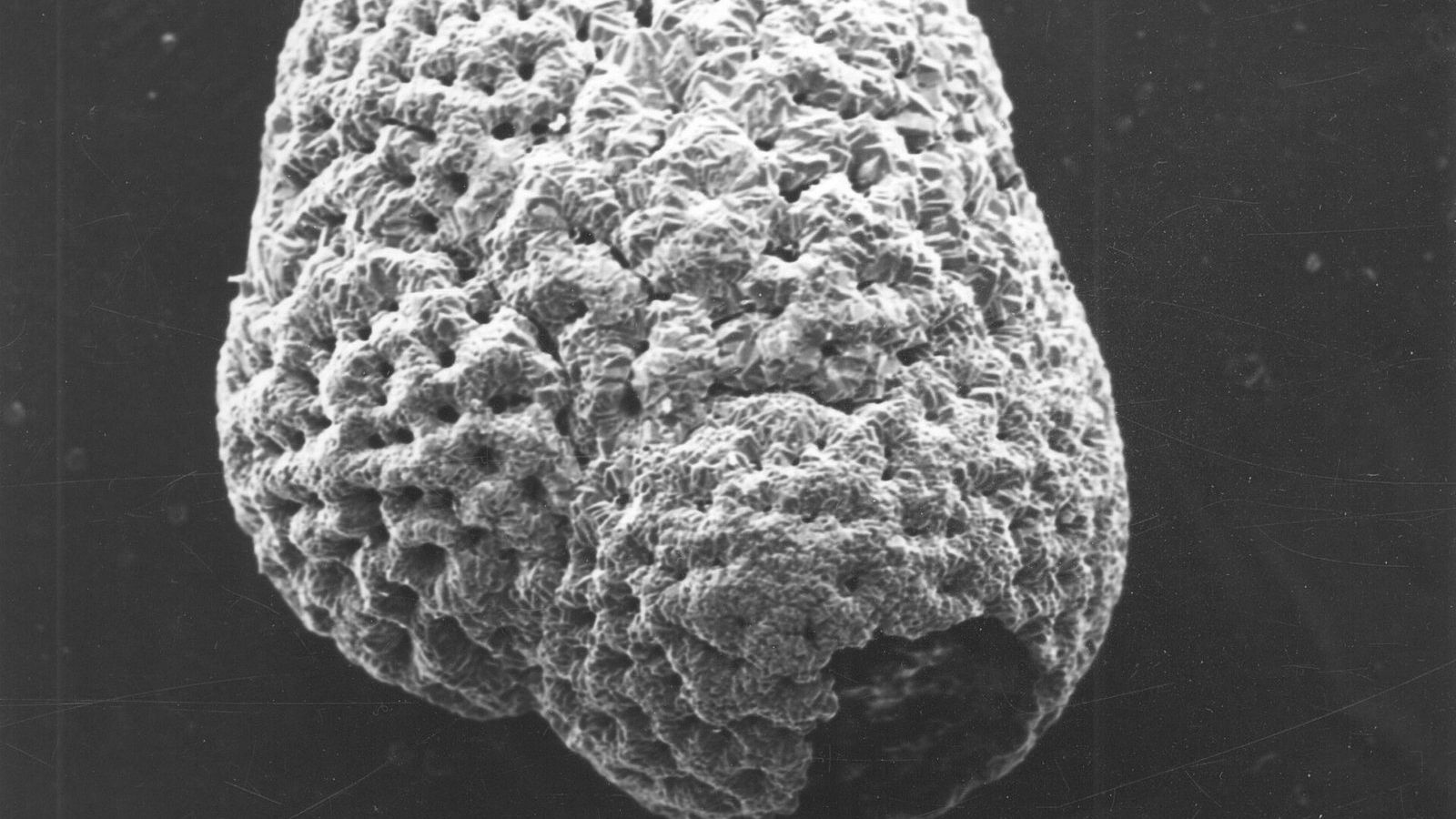
Foraminifera are single-celled organisms that live in the sea, some drifting near the surface and some on the bottom, and most of them build a shell of calcium carbonate a fraction of a millimetre across. When they die the shells sink, and on much of the seafloor they settle at a rate of a centimetre or two every thousand years. A core of deep-sea mud is therefore a stack of shells in order of age, and in 1947 the chemist Harold Urey realized that each shell carries a record of the temperature of the water it grew in. Reading that record is most of what palaeoceanography does.
Two kinds of oxygen
Oxygen atoms come in two stable kinds that matter here, the common oxygen-16 and the heavier oxygen-18, about one atom in 500. When a shell forms from seawater, the heavier atom is taken up slightly more readily at low temperature than at high, so a shell grown in cold water has a little more oxygen-18 than one grown in warm water. The difference is tiny and is expressed in parts per thousand relative to a standard:
\[ \delta^{18}\mathrm{O} = \left(\frac{R_{\mathrm{sample}}}{R_{\mathrm{standard}}} - 1\right) \times 1{,}000\ \text{‰}, \]where \(R\) is the ratio of oxygen-18 to oxygen-16. For shells the standard is a fossil belemnite from the Pee Dee formation of South Carolina, written VPDB. Urey calculated, and his students measured, that the shell's \(\delta^{18}\mathrm{O}\) falls by about 0.22 ‰ for every degree the water is warmer. A mass spectrometer can measure the ratio to about 0.05 ‰, which is a quarter of a degree. By 1951 Urey's group had read the seasons of the Jurassic from the growth rings of a belemnite.
Emiliani's stages
Cesare Emiliani, one of Urey's students, applied the method to deep-sea cores in 1955 and found that the \(\delta^{18}\mathrm{O}\) of surface-dwelling foraminifera swung up and down through the cores in a regular rhythm. He numbered the swings from the top, odd numbers for the warm stages and even for the cold, and his marine isotope stages are still the names palaeoceanographers use: we live in stage 1, the last ice age was stage 2, and the last warm period before ours, about 125,000 years ago, is stage 5e. Emiliani read the swings as temperature and concluded that the tropical sea had been about 6 °C colder in the ice ages. He was right that the swings were the ice ages. He was wrong about what they measured.
Shackleton's correction
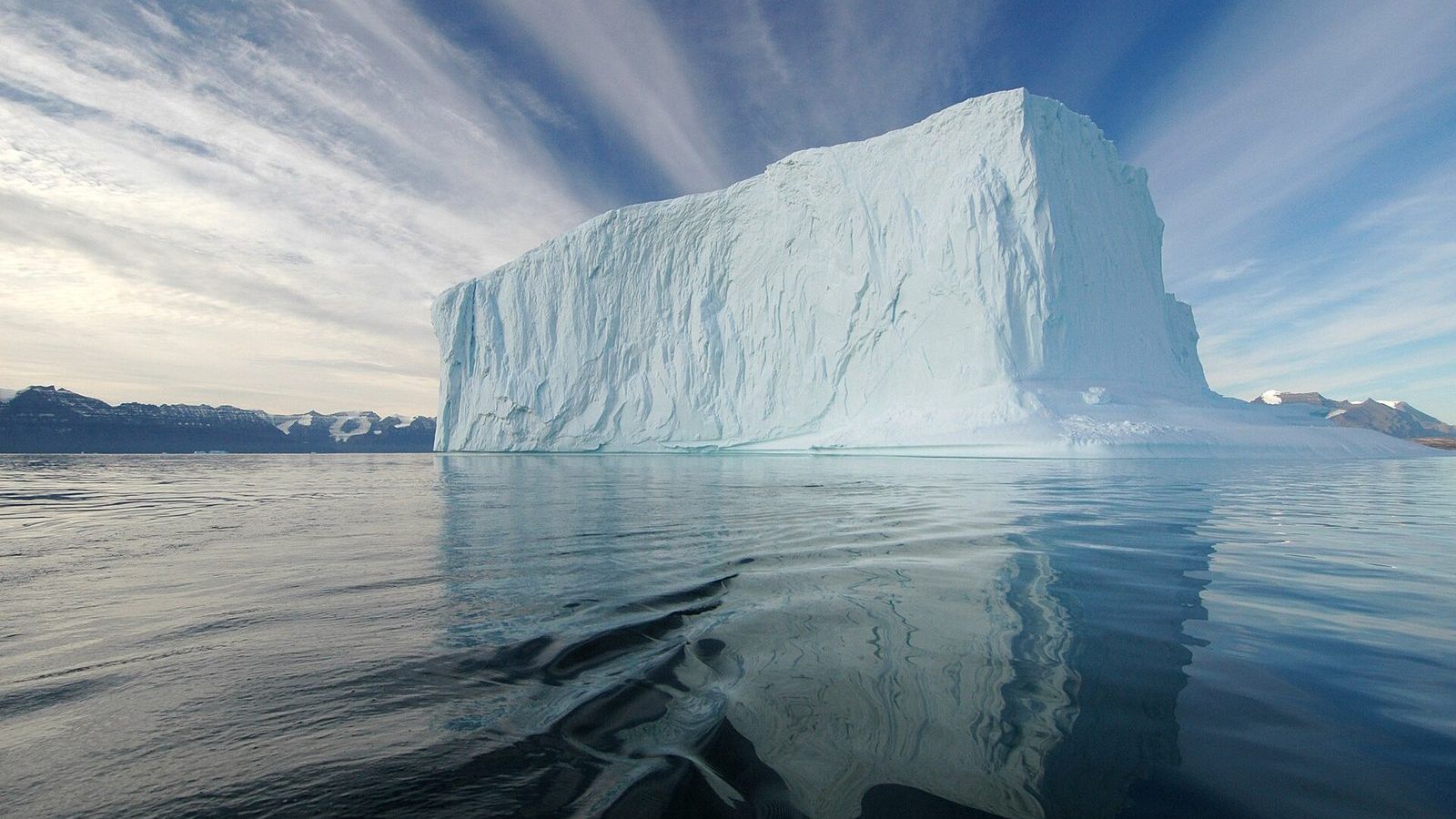
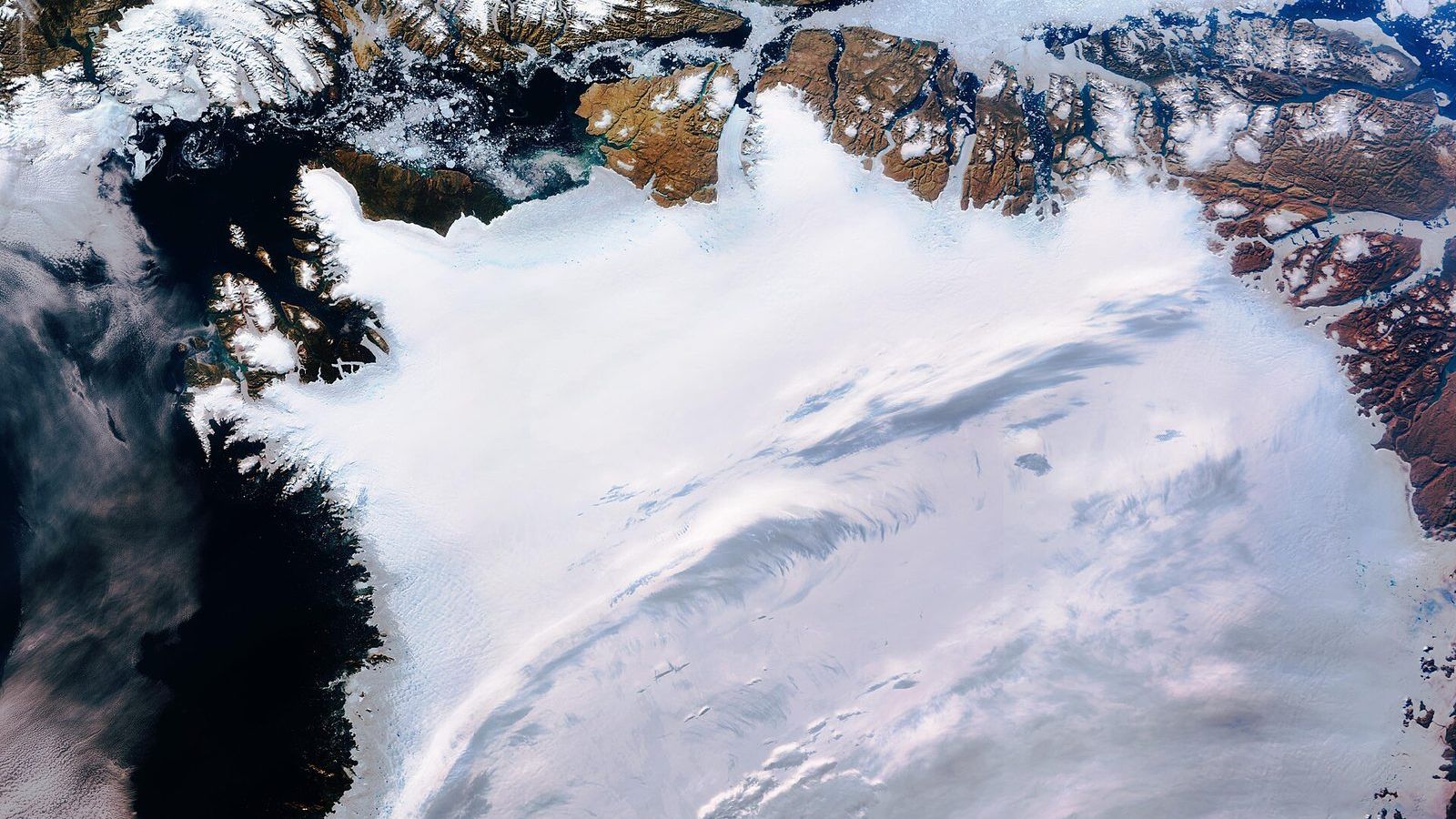
Water evaporating from the sea takes the lighter oxygen-16 preferentially, so rain and snow are depleted in oxygen-18 and the sea left behind is enriched. When that snow stays on land as an ice sheet instead of running back to the sea, the whole ocean becomes a little heavier in oxygen-18, and every shell in it records that shift regardless of temperature. Nicholas Shackleton, at Cambridge, showed in 1967 how to separate the two effects. He measured foraminifera that live on the deep seafloor, where the water is always near 2 °C and can hardly have been much colder in the ice ages, and found that their \(\delta^{18}\mathrm{O}\) swung by almost as much as the surface shells. The swing could not be temperature. It was the ice. Most of the signal Emiliani had read as cooling was the growth and melting of the ice sheets, and the deep-sea \(\delta^{18}\mathrm{O}\) curve became what it is today: primarily a record of how much ice the planet carried.
The numbers work like this. Lowering the sea by 120 m, which is what the ice sheets of the last glacial maximum did, removes about 3 per cent of the ocean's water as isotopically light ice, and raises the \(\delta^{18}\mathrm{O}\) of the remaining water by about 1.0 to 1.2 ‰, close to 0.01 ‰ per metre of sea level. The total glacial-to-interglacial swing in benthic shells is about 1.7 ‰. Subtract the ice part and about 0.5 ‰ is left for temperature, which at 0.22 ‰ per degree is a deep-ocean cooling of about 2 °C, consistent with what other methods find. For a surface-dwelling species in the tropics, where the total swing might be 1.5 ‰, the temperature part after removing 1.1 ‰ of ice effect is about 0.4 ‰, or less than 2 °C of cooling, well below Emiliani's 6 °C.
Dating the shells
A core gives a sequence but not, by itself, a date. Radiocarbon dates the top 50,000 years of it from the carbon in the same shells. Below that, the reversals of the Earth's magnetic field, recorded in the sediment's magnetic grains, give fixed points, the most recent at 773,000 years ago. Between the fixed points the record is matched to the known rhythms of the Earth's orbit, which is possible because, as Hays, Imbrie, and Shackleton showed in 1976, the ice ages follow those rhythms. In 2005 Lorraine Lisiecki and Maureen Raymo aligned 57 benthic records from around the world into a single stack, called LR04, that runs back 5.3 million years with a resolution of a few thousand years. It is the reference curve of the ice ages, and anyone can download it from the PANGAEA archive and plot it: a slow drift towards heavier values, meaning more ice, over five million years, with a sawtooth of a hundred thousand years superimposed on it for the last million.
Three thermometers are better than one
Because the oxygen isotopes mix ice and temperature, palaeoceanographers now measure temperature by other means in the same shells and the same mud. The ratio of magnesium to calcium in a foraminiferan's shell rises by about 9 per cent per degree, with no ice effect. The molecules called alkenones, made by a group of plankton, change their chemical structure with temperature. A third group of molecules, from marine archaea, gives the TEX86 thermometer. With temperature known from one of these, the oxygen isotopes give the ice volume, and so the sea level, with the temperature removed. The shells of the deep sea turn out to hold both a thermometer and a tide gauge, and the work of the last thirty years has been learning to read them apart.
Unit 13 of the Ocean Masterclass is the toolkit of palaeoceanography: how a core is taken and dated, the isotope definition and the palaeotemperature relation, the Mg/Ca and alkenone thermometers, and the LR04 stack in a research spotlight. Unit 14 uses the record to describe the glacial ocean. The full list of units is in the curriculum.